 sales@rajsuriindustries.com
 +91 9867293805
 Mon - Sat
10:00 - 7:00
Mon - Sat
10:00 - 7:00 
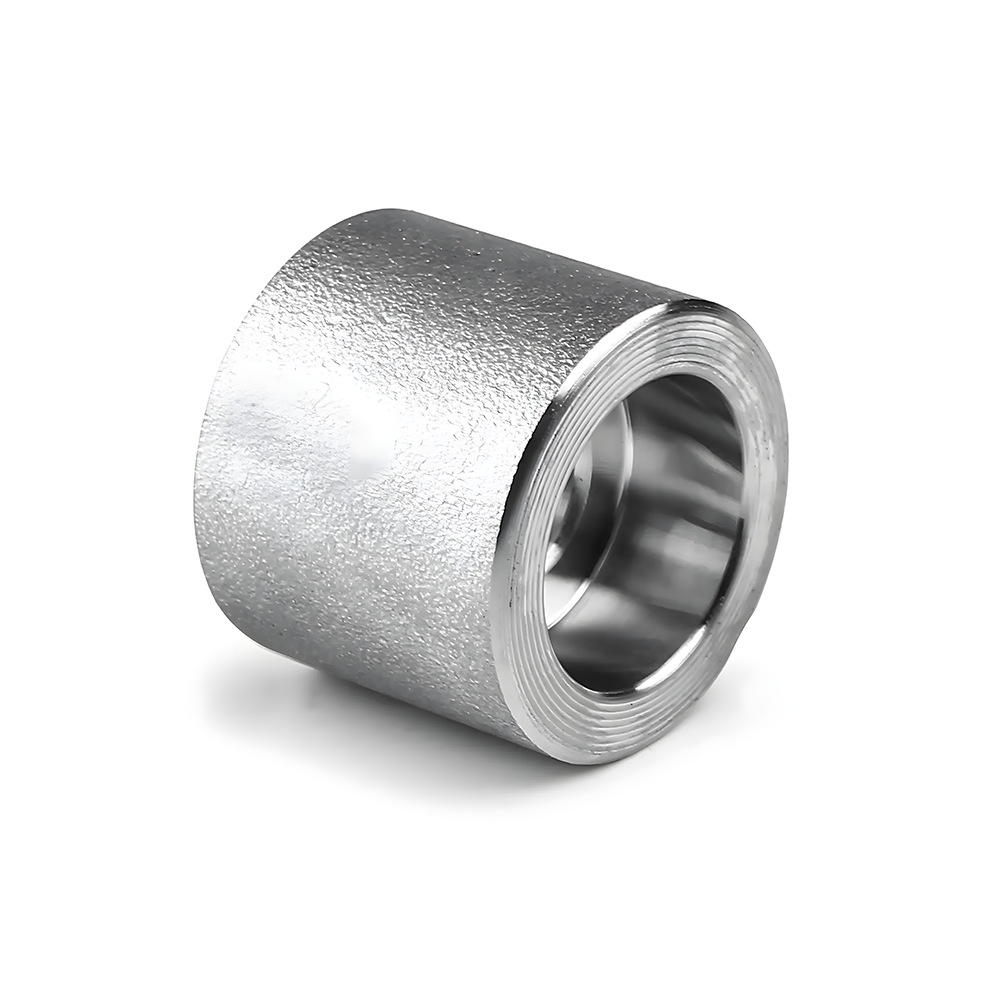
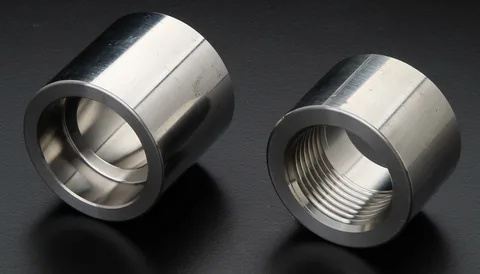
A forged fitting coupling is a pipe fitting used to connect two lengths of pipe or a pipe to a fitting in a straight line. It provides a strong, leak-proof joint and is commonly used in high-pressure and high-temperature applications. Couplings are essential in systems where secure, rigid connections are required, and are available in full, half, and reducing types to suit various piping configurations.
Manufactured through the forging process, these couplings are formed by compressing heated metal into the desired shape. This method enhances the mechanical strength and durability of the coupling, making it ideal for critical industrial systems. Forged couplings come with socket weld or threaded (NPT/BSP) ends and are offered in various materials like carbon steel, stainless steel, and alloy steel.
Specifications
| Specification | Details |
|---|---|
| Standards | ASME B16.11, MSS SP-83, BS 3799 |
| Size Range | 1/8” to 4” NPS (Nominal Pipe Size) |
| Types | Full Coupling, Half Coupling, Reducing Coupling |
| Pressure Ratings | Class 2000 (Threaded), Class 3000 & 6000 (Socket Weld) |
| Connection Types | Threaded (NPT/BSP), Socket Weld |
| Material Grades | Carbon Steel (ASTM A105), Stainless Steel (ASTM A182 F304, F316), Alloy Steel (A182 F5, F9) |
| Forming Method | Hot Forged & Machined |
| Temperature Range | Suitable for high-temperature environments (based on material grade) |
| Applications | Oil & Gas, Petrochemical, Power Generation, Marine, Chemical Processing |
Full Coupling
A Full Coupling is a type of forged pipe fitting used to connect two pipes of the same diameter in a straight line. It provides a leak-proof, strong, and durable connection, especially in systems operating under high pressure and high temperature. Full couplings are widely used in pipelines that require permanent joints and are available in socket weld and threaded (NPT/BSP) ends.
Forged full couplings are manufactured using the hot forging process, which enhances their strength and performance compared to cast or welded options. They are commonly made from materials like carbon steel, stainless steel, and alloy steel, depending on the application and required resistance to temperature, pressure, and corrosion.
Key Features
Straight inline connection for same-size pipes
Available inSocket Weld (SW) or Threaded (THD) ends
Pressure classes: 2000, 3000, 6000, 9000
Sizes typically range from 1/8” to 4” NPS
Half Coupling
A Half Coupling is a forged pipe fitting used to connect a pipe to a fitting, valve, or equipment where only one end of the coupling is joined to the pipeline. The other end is either socket weld or threaded, allowing a secure and strong connection. It is ideal for small-bore branching from a vessel or header, especially when the outlet needs to be reduced or terminated.
Half couplings are manufactured through the hot forging process, which enhances their strength, density, and reliability, making them suitable for high-pressure and high-temperature systems. These fittings are commonly used in various industries such as oil and gas, chemical processing, power generation, and hydraulic systems.
Key Features
One end is plain for welding; the other is threaded or socket weld.
Ideal forbranch connections or small-bore outlets
Pressure ratings: Class 2000, 3000, 6000.
Available in materials like carbon steel (ASTM A105), stainless steel (A182 F304/F316), and alloy steel (A182 F5, F9).
Size range: typically 1/8” to 4” NPS.
Standards: ASME B16.11, MSS SP-83, BS 3799.
Reducing Coupling
A Reducing Coupling is a forged pipe fitting designed to connect two pipes of different diameters in a straight line. It allows a smooth transition from a larger to a smaller pipe size, maintaining system flow and reducing turbulence. This fitting is commonly used in piping systems where space is limited or where a gradual change in pipe diameter is required without using separate reducers and couplings.
Manufactured by hot forging, reducing couplings offer excellent mechanical strength, leak-proof performance, and durability under high-pressure and high-temperature conditions. They are available in threaded (NPT/BSP) and socket weld configurations.
Key Features
Connects two pipes of different sizes.
Available withSocket Weld (SW) and Threaded (THD) ends.
Pressure classes: Class 2000, 3000, 6000.
Materials: Carbon Steel (ASTM A105), Stainless Steel (ASTM A182 F304/F316), Alloy Steel (ASTM A182 F5/F9).
Size range: From 1/8” to 4” NPS., with varying reduction options.
Standards: ASME B16.11, MSS SP-83, BS 3799.